How to Get a Builder’s Licence in Queensland (QBCC): Step by Step
To get a builder’s licence in Queensland, you apply to the Queensland Building and Construction Commission (QBCC) for a specific licence class and type. You’ll need to meet the technical qualification, and experience requirements for your chosen license class, pass on the fit and proper person assessment and, if you’re applying for a contractor-type licence, demonstrate that you meet the applicable minimum financial requirements. Most applicants underestimate the paperwork, and that’s usually where the delays creep in.
The details shift with the class you choose. The sections below follow the order most people work through, from picking a licence class to what happens once the licence lands.
Who needs a QBCC builder’s licence in Queensland?
Anyone who contracts to carry out building work valued over $3,300, including labour, materials and GST, needs the appropriate QBCC licence, according to the QBCC’s guidance on when you need a licence. Hydraulic services design has a separate licensing threshold of $1,100. Some work requires a licence regardless of value, including plumbing, drainage, gas fitting, termite management, fire protection, completed residential building inspections, certain building design services, site classification and mechanical services.
The threshold catches people out. A $2,900 deck repair sits under it. Quote $3,400 for the same job and you’re in licence territory, which is how plenty of tradies find out halfway through a quote that they’ve outgrown handyman work.
Employees of a licensed contractor generally don’t need their own contractor licence. However, employees responsible for supervising and directing building work, or ensuring its quality and compliance, must hold the appropriate QBCC licence. This includes nominee and site supervisors. Separate occupational licensing requirements may also apply to employees performing or supervising specialist trade work.
An owner-builder permit is a separate thing altogether. It allows an eligible property owner to carry out building work on their own property under the conditions of the permit. It isn’t a builder’s licence, and work performed under an owner-builder permit cannot be counted towards the experience requirements for a QBCC builder licence. A trust can’t hold a QBCC licence either. The individual or company acting as the trustee must apply instead.
What is a QBCC builder’s licence?
A QBCC builder’s licence is an authorisation, issued under the Queensland Building and Construction Commission Act 1991, that allows an individual or company to undertake or supervise a defined scope of building work, depending on the license type. The licence class sets what you can undertake. The licence type sets your role, such as contractor, site supervisor or nominee supervisor.
The QBCC assesses applications, checks that licensees stay compliant and can take action when they don’t. A licence also indicates that the applicant has met the relevant qualifications, experience and suitability requirements. It won’t, however, cover every type of work. Specialist activities such as plumbing, drainage and gas fitting, fire protection and mechanical services may require additional occupational licences or authorisations.
Which QBCC licence class do you need?
Most people looking to become residential builders consider the Builder (low rise) licence first. It covers residential work as well as certain smaller commercial buildings. Those planning to undertake larger or more complex projects may need a Builder (medium rise) or Builder (open) licence, depending on the scope of work.
The National Construction Code (NCC) sorts buildings into classes. Class 1 generally covers houses and townhouses, class 2 covers apartment buildings, and class 10 includes non-habitable structures such as sheds, carports and garages.
| Licence class | What it covers | Experience period |
| Builder (low rise) | Class 1 and class 10 buildings. Also covers classes 2–9 buildings with a gross floor area of up to 2,000 m², excluding Type A and Type B construction. | 4 years, or 2 years if qualified in carpentry or bricklaying and blocklaying |
| Builder (medium rise) | Class 1 and class 10 buildings, plus building work up to a maximum of 3 storeys, excluding Type A construction on classes 4–9 buildings. | 4 years, or 2 years if qualified in carpentry or bricklaying and blocklaying. |
| Builder (open) | Building work on all classes of buildings, without the low-rise or medium-rise scope limitations. | 4 years. The majority (more than 50%) of the experience must involve open-class work. |
| Builder (restricted) | Specific categories of work such as kitchens, bathrooms and laundry installation, shopfitting, structural landscaping and special structures such as shade sails and signs. | Generally 4 years, or 2 years with an eligible trade qualification. The accepted qualifications depend on the restricted class. |
A separate QBCC trade contractor licence is available for specific trades, including carpentry, bricklaying, plumbing, plastering and tiling. It allows contractors to undertake work within their approved trade licence scope, rather than manage an entire building project like a licensed builder. Some projects also require additional occupational licences for specialist services, even when the contractor holds a builder’s licence.
What qualifications do you need for a QBCC builder’s licence?
The QBCC requires proof of technical competence for your licence class. In practice, this means holding a nationally recognised building and construction qualification that meets the requirements for your chosen license. The specific qualification depends on the class and licence type, so check the Queensland Government’s Technical Qualifications for Licensing document before enrolling.
The QBCC accepts different forms of evidence, including formal qualifications from a Registered Training Organisation (RTO), course completion documents, an RPL certificate issued by an RTO, or a qualification statement from an approved authority. If you hold a different but potentially equivalent qualification, you may be able to apply for an equivalency assessment.
The CPC40120 Certificate IV in Building and Construction is the specified technical qualification for a Builder (low rise) contractor or nominee supervisor licence.
Builders Institute’s Certificate IV in Building and Construction covers estimating, contracts, building codes, site supervision and project coordination, which are important areas of knowledge for residential builders.
For a Builder (medium rise) contractor or nominee supervisor licence, the specified qualification is the CPC50220 Diploma of Building and Construction (Building). It covers more advanced construction planning, structural principles, risk and financial management, estimating, contracts and project supervision. Many students choose to complete the Diploma of Building and Construction after the Certificate IV.
For a Builder (open) contractor or nominee supervisor licence, the specified technical qualification is the CPC60220 Advanced Diploma of Building and Construction (Management). This qualification develops the higher-level knowledge required to manage larger and more complex building projects.
These qualifications aren’t interchangeable, and finishing one doesn’t guarantee a licence. Applicants must also meet the relevant experience, financial and other eligibility requirements. If you’re weighing it up, our guide on whether you need a Certificate IV to get a builders licence is a good place to sort out the gap between what you hold and what your target class asks for.
Whichever course you pick, confirm the provider is listed on training.gov.au, the national register of RTOs and qualifications. Builders Institute is RTO 45904. The Australian Skills Quality Authority (ASQA) is the national VET regulator, although some RTOs are regulated by other state or territory authorities. Always check the provider’s registration and the status of the specific qualification before enrolling.
How much experience do you need for a QBCC builder’s licence?
For Builder (low rise), the QBCC requires four years of relevant experience, or two years if you hold a trade qualification in carpentry or bricklaying and blocklaying. Builder (medium rise) has the same experience periods, with a two-year pathway available for applicants qualified in carpentry or bricklaying and blocklaying. Builder (open) requires four years of relevant experience, with no equivalent two-year trade qualification concession. More than 50% of the experience claimed for an open licence must involve open-class work.
The QBCC cares about what you did, not simply how long you were on site. Its Builder Low Rise Application Guide lists the typical stages of a build and asks applicants to provide examples of work they personally performed or supervised. This includes preliminary planning, site preparation, footings, framing, enclosed and fit-out stages, practical completion, defect inspections and submitting final approval documentation, plus project management.
Three important limitations apply to experience claims. Experience gained as part of a training course or apprenticeship is not accepted. Work performed under an owner-builder permit, or under the supervision of an owner-builder, is also excluded. Experience gained before completing the required technical qualification is generally not preferred, but it is not automatically excluded. The QBCC may consider it where you were employed by an appropriately licensed contractor, taking into account the nature of the work and your responsibilities at the time.
For example, if you completed your Certificate IV in March 2026 but had relevant site supervision experience in 2023, the QBCC may consider that earlier experience if you can demonstrate that you were employed by an appropriately licensed builder and had the relevant responsibilities. It will assess the supporting evidence before deciding whether the experience can count.
How do experience declarations and referee reports work?
You document your experience in the QBCC experience record, and a referee verifies the work you have listed by signing the relevant experience declaration alongside you. Both you and your referee must sign and confirm that the information is true and correct. The referee should ideally hold a licence or qualification at the same level as, or higher than, the class you’re applying for, and must be able to confirm your on-site experience. If you can’t name appropriately licensed contractors, the QBCC may consider a referee in a supervisory or managerial role with the company, however, you will still need to provide sufficient evidence to demonstrate that your experience claims are accurate.
Specifics win here. Writing ‘site supervisor, 2021 to 2024’ tells an assessor very little. Writing that you coordinated the frame, lock-up and fit-out trades on 14 detached homes, ran the frame inspections and handled the final defect list gives them something more substantial to assess. Ask your referee early, too. The QBCC may contact referees to verify the information in your application, so make sure their contact details are current and that they are available to confirm your experience.
Can you use recognition of prior learning for a builder qualification?
Yes. Recognition of Prior Learning (RPL) lets an RTO assess your existing skills and knowledge against a qualification’s competency requirements, and the QBCC accepts an RPL certificate from an RTO as evidence of your technical qualification provided it meets the requirements for the license class you’re applying for. It suits experienced carpenters, supervisors and construction managers who have developed their skills through practical industry experience rather than in a classroom.
You’ll generally need to provide supporting evidence of your previous work, skills and knowledge. This may include workplace records, project documents, previous training certificates and other relevant evidence. The RTO will assess your submission and determine whether you meet the required competencies. You may still need additional training or assessment to address any gaps. RPL also doesn’t replace the QBCC’s separate experience, fit and proper person and financial requirements. Our guide on how to get qualified through RPL in the construction industry walks through the evidence you’d gather.
What are the QBCC minimum financial requirements?
Contractor licence applicants must meet the QBCC’s minimum financial requirements (MFR), which cover three measures: a current ratio, net tangible assets and a maximum revenue limit. The QBCC expects you to meet the current ratio when you apply and at all times while you hold the licence, so it isn’t a one-off hurdle.
The current ratio measures your ability to meet short-term financial obligations by comparing current assets with current liabilities. The minimum requirement is 1:1, meaning you must have at least $1 in current assets for every $1 in current liabilities.
Net tangible assets (NTA) represent the value of your total assets after deducting liabilities, intangible assets and any disallowed assets. Your NTA position helps determine your maximum revenue (MR), which is the annual turnover limit the QBCC allows your business to earn.
The financial information you need to provide depends on your maximum revenue category. Licensees in SC1 and SC2 categories (up to $800,000) generally submit an MFR declaration, while those in Categories 1–7 (above $800,000) must provide an MFR report prepared by an appropriately qualified independent accountant.
Your business structure, whether you operate as a sole trader, partnership, trust or company, also affects which assets and liabilities can be included in your financial calculations. It’s worth consulting an accountant familiar with the QBCC’s MFR requirements before lodging your application.
Individual site supervisor and nominee supervisor licences carry different financial settings, so check the requirements for the type you’re applying for.
Do you need a business or managerial qualification?
The QBCC has separate technical and managerial qualification requirements, depending on the licence class and type you’re applying for. Certain licence types, including trade contractor and trade nominee supervisor licences, require an approved managerial qualification. The prescribed unit is BSBESB402 – Establish legal and risk management requirements of new business ventures.
However, this requirement does not automatically apply to every builder licence applicant. Builder applicants must meet the technical qualification and other eligibility requirements relevant to their intended licence class and type.
Business knowledge is still valuable when running a construction business. Understanding quoting, contracts, record keeping, cash flow and subcontractor payments can help you manage projects effectively and maintain a financially sustainable operation.
Which licence type do you need: contractor, site supervisor or nominee supervisor?
The licence type should match the role you’ll actually play in the building industry. Choosing the wrong type can leave you unable to enter into building contracts or perform the supervisory responsibilities you intend to take on
| Licence type | What it allows | Who it suits |
| Contractor | Allows an individual or company to enter into contracts for building work within the scope of its licence. An individual contractor can also supervise building work. | Individuals operating as sole traders and companies running their own building businesses. |
| Site supervisor | Allows an individual to personally supervise building work carried out under their employer’s contractor licence. It does not allow them to independently contract for building work. | Employees or officers of licensed contractors who are responsible for supervising construction work. |
| Nominee supervisor | Allows an individual to supervise building work under a company’s contractor licence and fulfil the technical supervisory responsibilities of the company’s nominee. | Qualified directors, secretaries or employees nominated by a licensed company. |
A company that wants to contract for building work generally needs its own QBCC contractor licence, even if its nominee holds an individual licence. The company must also nominate an appropriately licensed individual who holds a contractor or nominee supervisor licence in the same class. If the nominated person does not yet hold the required individual licence, the QBCC allows the company to submit the nominee’s individual licence application at the same time as the company licence application. The nominee must also be a director, secretary or employee of the company.
How do you apply for a QBCC builder’s licence?
You apply on the QBCC’s builder licence application form, with your supporting documents and the full fee. The QBCC reviews the application, assesses your knowledge and experience, asks for more information if needed, checks your referees, makes a decision and notifies you. It won’t start assessing until the fee is paid in full, and it won’t approve until every required document has arrived.
- Confirm your class and type. Check that the class covers all the work you intend to do.
- Get the current QBCC application forms and read the instructions for your class.
- Collect your evidence: photo identification, proof of permission to work in Australia, a passport-style photo for your licence card, qualification documents, experience declarations and signed referee records.
- Add the financial paperwork if you’re applying for a contractor licence, plus any business structure documents for a company, partnership or trading name.
- Check all details before submission. Make sure your name, contact details and other information are consistent across your identification, qualification documents and application form. Include any supporting documents requested in the application checklist.
- Submit your application and arrange payment. The QBCC currently accepts builder licence applications through three channels:
- By email: Send your completed application and supporting documents to li******************@**********ov.au.
- In person: Visit a QBCC Customer Service Centre.
- By post: Send your completed application and supporting documents to GPO Box 5099, Brisbane QLD 4001.
If you submit by email or post, the QBCC will contact you to arrange payment. If applying in person, you can pay at the service centre. Your application will not proceed to assessment until all required documents and payments have been accepted.
- Keep copies of everything you send and every reply you get, and answer any request for more information quickly.
How much does a QBCC builder’s licence cost?
QBCC application fees depend on your licence type and, for contractor licenses, your maximum revenue category. The fees also differ depending on whether you’re applying as an individual or a company.
For builder contractor licences, the QBCC’s financial categories include:
- SC2: Maximum revenue up to $800,000 per year.
- Category 1–2: Maximum revenue up to $12 million per year.
- Category 3–7: Maximum revenue above $12 million per year.
SC1, which covers maximum revenue up to $200,000, is not available for builder licences.
The QBCC’s published fee schedule lists different charges for individual and company applicants. For example, the listed company contractor fees range from approximately $1,673 to $3,076 across the available builder financial categories. Individual contractor fees are lower. Existing QBCC individual licence holders applying for another class may also qualify for reduced fees.
ees are subject to annual indexation, generally taking effect on 1 July. Always check the QBCC licence fees schedule before lodging your application.
Remember to budget for additional expenses, including your qualification or RPL assessment, any gap training required and professional accounting fees for preparing an MFR report, where applicable. These costs are separate from the QBCC’s licensing fees.
How long does it take to get a QBCC builder’s licence?
Once your qualifications and evidence are in hand, assessment is the main wait. The original draft of this guide cited about eight weeks as the QBCC’s general guide [VERIFY: current published QBCC processing time]. Incomplete forms, thin experience descriptions, referee checks and financial queries can stretch it.
The bigger delay is usually before you lodge. If you still need the qualification or a few more years of eligible experience, think in years rather than weeks.
What happens after your QBCC licence is approved?
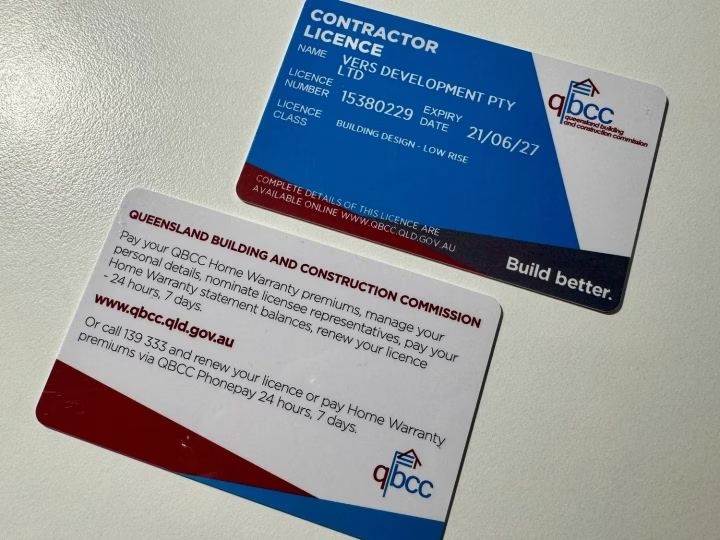
Once your application is approved, the QBCC will issue your licence card and licence letter, confirming your licence number, approved class and scope of work. Review these details carefully before accepting any building projects or signing contracts. You must only undertake work that falls within your approved licence scope and comply with any conditions attached to your licence.
If you’re operating as a contractor undertaking residential construction work, you must also understand your obligations under the Queensland Home Warranty Scheme. Insurance cover is generally compulsory for insurable residential construction work valued at more than $3,300, including materials, labour and GST.
The licensed contractor who enters into the contract with the homeowner must collect the insurance premium and pay it to the QBCC. This must be done before work begins or within 10 business days of signing the contract, whichever happens first. The scheme does not apply to all building work, so check the QBCC’s insurance requirements for your particular project.
You must also ensure your building work complies with the National Construction Code (NCC), applicable Queensland building legislation and relevant standards. Maintain your financial position within the QBCC’s minimum financial requirements, keep appropriate business and project records, and notify the QBCC of relevant changes to your licence or business details.
How do you upgrade a QBCC builder’s licence?
You apply for the additional class, and you must meet that class’s qualification and experience requirements. It isn’t automatic. A low rise builder heading for medium rise or open work will usually need further education and supervisory experience on bigger projects.
Start documenting suitable jobs well before you apply. Check what a larger scope does to your insurance, contracts and financial requirements too, because a bigger licence usually means a bigger revenue category.
Can interstate builders get a Queensland builder’s licence?
Yes. Builders who hold an eligible licence in another Australian state or territory, or New Zealand, may be able to obtain an equivalent Queensland licence through mutual recognition under the Mutual Recognition Act 1992 (Cth).
The QBCC assesses your existing licence to determine which Queensland licence class and type is equivalent. However, mutual recognition does not automatically give you unrestricted building rights in Queensland. If your interstate licence has conditions or restrictions, the QBCC must apply equivalent conditions to your Queensland licence. The QBCC may also be unable to grant a licence if there is no equivalent Queensland licence for your existing registration.
Your interstate licence must remain active until your Queensland application is approved. If you’re planning to operate through a company in Queensland, remember that the company must obtain its own QBCC contractor licence. Mutual recognition applies to individuals, not companies or partnerships.
If you’re coming from Victoria, our guide on how to get a builder’s licence in Victoria explains how the licensing pathway differs in your home state.
Before accepting any Queensland building contracts, check that your Queensland licence has been issued and that its approved scope covers the work you intend to undertake.
What are the most common mistakes in QBCC licence applications?
The first is picking the wrong class, such as a residential renovator assuming that experience covers unrestricted commercial work. The second is thin experience evidence: vague job descriptions, unclear dates or a referee who can’t speak to what you actually did.
The third is assuming a Certificate IV or Diploma is a licence in waiting. It’s one part of an assessment that also weighs experience, fit and proper person checks and finances. The fourth is mixing up an individual supervisory licence with permission to contract in your own name. Applicants who review their eligibility early and keep project records as they go tend to have a smoother run. [Trainer tip: swap in a real example from Builders Institute trainers before publishing.]
What should you do next?
Start with the QBCC’s technical qualification requirements for the licence class you want to apply for. Compare the prescribed qualifications and experience requirements with what you already hold. This will help you identify whether you need to complete additional training, undertake an RPL assessment or gain more relevant industry experience. If a qualification is the missing piece, Builders Institute’s building and construction training is a good place to start. Our team can help you explore the available training options based on your qualifications and industry experience.
You can also begin documenting your construction experience and contacting potential referees early. Keeping accurate project records and securing referee support well before submitting your application can help make the licensing process smoother.
FAQs
What is a QBCC licence and who needs one in Queensland?
A QBCC licence is an authorisation issued by the Queensland Building and Construction Commission that allows individuals and businesses to carry out or contract for regulated building work in Queensland. For most building work, a contractor licence is required when the value exceeds $3,300, including labour and materials. Certain specialised work requires a licence regardless of the project value. The required licence class and type depend on the work being performed and the applicant’s role
What financial threshold requires a QBCC licence in Queensland?
Most building work valued at more than $3,300 requires the appropriate QBCC contractor licence. However, certain activities have different thresholds or require licensing regardless of value. For example, hydraulic services design requires a licence when the work exceeds $1,100, while plumbing, drainage, gas fitting and certain other regulated activities require the relevant licence regardless of value
What qualifications are required to get a QBCC Builder Low Rise licence?
Applicants must demonstrate that they hold the technical qualifications prescribed or recognised by the QBCC for the Builder Low Rise licence class. CPC40120 Certificate IV in Building and Construction is a relevant qualification pathway, but applicants should check the QBCC’s current technical qualification requirements before enrolling. They must also satisfy the applicable experience, referee and other eligibility requirements
What qualifications do I need for a QBCC Builder Medium Rise licence?
Applicants seeking a Builder Medium Rise contractor or nominee supervisor licence generally need to hold CPC50220 Diploma of Building and Construction or a qualification the QBCC considers equivalent. The Commission assesses equivalency based on course content and competency coverage, not simply the Australian Qualifications Framework level of the qualification. Relevant industry experience and other eligibility requirements must also be met.
How do I qualify for a QBCC Open Builder licence?
A QBCC Builder Open licence allows the holder to undertake building work within the broad scope specified for that licence class. Applicants must demonstrate the technical qualifications and experience prescribed by the QBCC for this class. They must also provide evidence of relevant supervisory, administrative and management experience. Do not assume that an Advanced Diploma or university degree automatically qualifies you. The QBCC assesses whether your qualification meets its prescribed technical requirements or is considered equivalent.
How much practical experience is needed for a QBCC builder licence?
The experience requirement depends on the builder licence class and your existing trade qualifications. For Builder Low Rise, applicants generally need two years of relevant experience if they hold a carpentry, bricklaying or blocklaying trade qualification, or four years if they do not hold one of these specified trade qualifications. For other builder classes, the QBCC applies separate experience requirements, including evidence of work appropriate to the relevant building scope. Experience must be properly documented and supported by suitable referees.
Can I get a QBCC builder licence through Recognition of Prior Learning (RPL)?
Yes, an applicant may obtain the required technical qualification through Recognition of Prior Learning (RPL), provided the assessment is completed by an appropriate Registered Training Organisation (RTO) and results in a qualification or certificate accepted by the QBCC. RPL allows an RTO to assess existing skills, knowledge and workplace experience against the required competencies. Additional training or assessment may be necessary if gaps are identified. However, obtaining a qualification through RPL does not automatically satisfy the QBCC’s separate experience, financial and other licensing requirements.
What are the Minimum Financial Requirements (MFR) for QBCC licence holders?
QBCC Minimum Financial Requirements apply to contractor-type licence holders. They are designed to ensure that building businesses maintain sufficient financial capacity to operate sustainably. The requirements include a minimum current ratio of 1:1, adequate net tangible assets (NTA) and compliance with the approved maximum revenue limit. For example, the SC2 category requires at least $46,000 in NTA and allows maximum revenue of up to $800,000, subject to the QBCC’s assessment and approval. The applicable financial category determines the financial information that must be provided.
What is an MFR report for QBCC?
An MFR report is a financial assessment prepared by an appropriately qualified independent accountant to demonstrate that a contractor meets the QBCC’s Minimum Financial Requirements. It examines the contractor’s financial position, including net tangible assets, current ratio and maximum revenue. Applicants in SC1 and SC2 categories generally provide an MFR declaration instead, subject to the QBCC’s requirements. Applicants in Categories 1–7 generally require an MFR report prepared by an independent qualified accountant.
What is the difference between a Nominee Supervisor and a Site Supervisor licence in Queensland?
A Nominee Supervisor licence allows an individual to act as the nominated supervisor of a licensed company and take responsibility for supervising the company’s building work within the relevant licence class. A Site Supervisor licence allows an individual to supervise building work within the scope of their licence while working in a supervisory role. It does not authorise the individual to independently contract for building work. Both licence types have specific eligibility and supervisory requirements.
Can I transfer my NSW or interstate builder licence to Queensland?
Eligible builders holding a current licence in another Australian state or territory, or New Zealand, may apply for an equivalent Queensland licence through mutual recognition under the Mutual Recognition Act 1992 (Cth). The QBCC assesses the existing licence to determine the equivalent Queensland class and type. Any conditions or restrictions attached to the original licence must also apply to the Queensland licence. Mutual recognition applies to individuals, not companies or partnerships.
How long does QBCC take to process a builder licence application?
The QBCC recommends allowing approximately eight weeks for a builder licence application to be processed. However, this is a guide rather than a guaranteed timeframe. Applications may take longer if the QBCC needs to assess qualifications, verify experience and referee declarations, review financial information or conduct fit and proper person checks. Incomplete applications or requests for additional documents may also cause delays.
What is the QBCC Fit and Proper Person test?
The QBCC’s fit and proper person assessment helps determine whether an applicant is suitable to hold a licence. The Commission considers factors such as honesty and integrity in commercial dealings, compliance with statutory obligations, previous defective building work, outstanding enforcement matters and relevant criminal history. Applicants must disclose relevant criminal convictions within the specified period and provide additional documentation where required. The QBCC assesses each application based on the circumstances and relevant licensing requirements.
What referee reports are required for a QBCC builder application?
Applicants must submit experience records and referee declarations confirming their relevant construction experience and competencies. These records should describe the projects undertaken, the building work involved, the dates and the applicant’s specific responsibilities. Ideally, referees should hold a licence or qualification at the same or higher level as the licence being sought and be able to personally verify the applicant’s experience. The applicant and referee must both sign the relevant experience records. The QBCC may consider alternative referees in supervisory or managerial positions where appropriately licensed contractors cannot be provided.
Can I contract for residential building work as an individual sole trader in QLD?
Yes, an individual can hold a QBCC Contractor licence as a sole trader, provided they meet the technical, experience, character, and financial criteria.
What happens if I carry out building work in Queensland without a QBCC licence?
Carrying out, offering to carry out or contracting for building work without the appropriate QBCC licence is unlawful unless a specific exemption applies. This also includes undertaking work outside the scope of an existing licence. Penalties can include substantial fines and prosecution. Repeat or serious offences may result in imprisonment of up to one year. Unlicensed contractors may also face restrictions on their ability to obtain a licence in the future.
What is the Queensland Home Warranty Scheme insurance requirement?
The Queensland Home Warranty Scheme (QHWS) provides financial protection to homeowners undertaking eligible residential construction work. Licensed contractors must collect the insurance premium from the homeowner and pay it to the QBCC for insurable residential construction work valued at more than $3,300, including labour, materials and GST. The premium must be paid before work begins or within 10 business days of signing the contract, whichever occurs first. The scheme can provide protection for eligible losses involving incomplete work, defective work and subsidence, subject to its terms, conditions and exclusions. It does not apply to all building projects, including commercial construction.
What is an ASIC extract, and why is it needed for a company QBCC licence?
An Australian Securities and Investments Commission (ASIC) extract provides official information about a company’s registration and corporate details. For a company QBCC licence application, the Commission requires a current and historical company extract to verify the company’s details and relevant officeholder history. The historical extract must be no more than 30 days old when the application is lodged. A current company extract alone is not accepted.
What managerial qualifications are mandatory for a QBCC contractor licence?
Managerial qualification requirements depend on the licence class and type being sought. Some QBCC licence categories require applicants to demonstrate approved business or managerial competencies in addition to their technical qualifications. However, it is incorrect to suggest that every builder contractor applicant must complete a separate managerial course. Applicants should check the QBCC’s prescribed requirements for their specific licence class before enrolling in additional training.
Do I need a QBCC licence to work as an employee on a construction site?
Generally, employees carrying out building work under a licensed contractor do not need their own contractor licence, provided they are lawfully employed and the work is covered by their employer’s licence. However, employees who are responsible for supervising and directing building work, overseeing quality control or ensuring compliance with plans and specifications may need an appropriate QBCC site supervisor or nominee supervisor licence. Certain specialised activities also require separate occupational licences.
How do I upgrade my QBCC licence from Low Rise to Medium Rise?
To upgrade from Builder Low Rise to Builder Medium Rise, you must apply for the additional licence class and demonstrate that you meet the relevant technical qualification and experience requirements.
Applicants generally need CPC50220 Diploma of Building and Construction or a qualification accepted as equivalent by the QBCC. They must also demonstrate relevant medium-rise building experience and provide supporting referee declarations. Approval is subject to the QBCC’s assessment of the application.
Can I get a QBCC builder licence without holding a traditional trade background?
Yes, a traditional trade qualification is not compulsory for every builder licence pathway. Applicants without a carpentry, bricklaying or blocklaying trade qualification may still qualify if they hold the required technical building qualification and demonstrate the relevant industry experience. For example, Builder Low Rise applicants without one of the specified trade qualifications generally need four years of relevant experience. The QBCC assesses whether the experience demonstrates the necessary practical, supervisory and management competencies.
What is the minimum age to apply for a QBCC licence?
Applicants must satisfy the QBCC’s eligibility requirements, including having permission to work in Queensland and providing valid proof of identity. The application must also meet the requirements applicable to the chosen licence type.
How do I maintain my QBCC licence once approved?
To maintain your QBCC contractor licence, you must continue meeting the applicable licensing and Minimum Financial Requirements. This includes maintaining the required current ratio, net tangible assets and maximum revenue limits. Contractor licensees subject to annual financial reporting must submit the required information each year. This includes companies holding contractor licences regardless of financial category and individuals with approved maximum revenue above $800,000. Individual licensees in SC1 and SC2 are generally exempt from annual financial reporting but must still meet their MFR obligations. You must also pay applicable renewal fees, notify the QBCC of relevant changes to your licence or business details and comply with Queensland building legislation.
How are National Construction Code (NCC) standards enforced by the QBCC?
The National Construction Code (NCC) establishes the minimum technical requirements for building design and construction in Australia. In Queensland, these requirements are adopted through the applicable state building legislation and regulations. The QBCC regulates licensed building contractors and investigates compliance issues, including defective building work and breaches of licensing obligations. Licensed builders must ensure their work complies with the applicable NCC requirements, Queensland building legislation, approved plans and relevant standards. Building certifiers and other regulatory authorities also have roles in assessing and overseeing building compliance.