How to Apply for an Individual Contractor Licence in NSW
To apply for an individual contractor licence in NSW, you first work out which trade category your work falls under, then gather evidence of your qualifications and experience, complete the application, provide the required identity and supporting documents, and lodge it at a Service NSW Centre. Building Commission NSW assesses the application against the relevant qualification, experience and fitness requirements and may request additional information before making a decision.
If you’ve been working as an employee and want to run your own jobs, quote your own work, or take on subcontractors, this guide walks through exactly what NSW expects, in the order you’ll actually need it.
What is an individual contractor licence in NSW?
An individual contractor licence lets a sole trader or independent tradesperson legally contract, subcontract, or and advertise for regulated building and trade work in New South Wales. It’s the licence most solo traders need before they can put their own name on a quote.
Holding one signals to clients that you’ve met NSW’s bar for qualifications, hands-on experience, and conduct in your trade. Builders, carpenters, bricklayers, plumbers, electricians and air conditioning technicians all sit under this same licensing framework, just in different categories, so the paperwork looks similar even when the trade doesn’t.
Who actually needs a contractor licence in NSW?
You need one if you’re pricing jobs, signing a contracts with customers, advertising your services under your own name, or managing subcontractors on a site. Working as an employee under someone else’s licence is different, and doesn’t require you to hold your own For residential building and trade work, a contractor licence is generally required when the work is valued at more than $5,000 including GST. Specialist work, such as electrical, plumbing, gas fitting and air conditioning or refrigeration, requires the appropriate licence regardless of the job value.
People who typically need to apply include:
- Builders running residential construction projects
- Carpenters doing structural or renovation work
- Bricklayers and other masonry specialists
- Plumbers and electricians in regulated categories
- Air conditioning and mechanical services contractors
- Any tradesperson completing licensed work categories under their own name
The category matters. A carpentry licence doesn’t cover electrical work, and applying under the wrong one is a common reason applications stall.
What are the eligibility requirements?
NSW assesses three broad things: whether you’re qualified for the trade, whether you’ve got enough hands-on experience, and whether you’re a “fit and proper person” to hold a licence. That last point covers things like your character, honesty, and compliance history and, in some categories, your financial standing.
Typical requirements include a recognised trade qualification (or equivalent experience pathway), proof of identity, evidence of practical industry experience, and any supporting forms specific to your category. Requirements shift depending on whether you’re applying for general building work or a specialist trade like plumbing or electrical, so it pays to check your specific category page rather than assume it matches a mate’s experience in a different trade.
What qualifications and experience count?
Most applicants need a recognised trade qualification, whether that’s a full trade certificate, a relevant statement of attainment, or documented equivalent experience where a formal qualification pathway allows it. A Certificate IV in Building and Construction is one of the more common qualifications builders use to demonstrate they meet the technical knowledge component, particularly for those managing residential projects rather than working purely on the tools.
Keep your employment records tidy well before you apply. You may also need to demonstrate relevant practical industry experience. Supporting evidence can include referee statements, group certificates, and dated project records all help build a picture of genuine industry experience, and assessors will ask for specifics if your application is thin on detail. One thing trainees often get wrong: they assume a course completion alone is enough, when NSW usually wants evidence you’ve actually applied that qualification on real jobs for a set period first.
How do you apply, step by step?
Once you’ve confirmed your category and pulled together your evidence, the process itself is fairly linear.
| Step | What it involves |
| 1. Confirm eligibility | Check the licence category matches the work you’ll do |
| 2. Gather your documents | Qualifications, experience records, identity documents, National Police Check and any other documents required for your category. |
| 3. Complete the form | Complete the relevant individual licence application form. |
| 4. Book your appointment | Individual contractor licence applications are generally lodged in person at a Service NSW Centre. |
| 5. Submit and pay | Attend your appointment with your application and pay the applicable fee |
| 6. Wait for assessment | Building Commission NSW reviews and either approves, queries, or declines |
Missing paperwork at step 2 is what causes most of the delay at step 6, so it’s worth double-checking every document against the checklist for your specific category before you lodge anything.
What documents do you need?
You’ll generally need proof of identity and address, your qualification certificates or statements of attainment, evidence of relevant industry experience, employment history details, and any referee statements your category requires. Depending on the licence category, you may also need a National Police Check and other supporting information about your background.
Make sure your documents are complete and up to date before submitting your application. Missing or incorrect documents can lead to requests for further information and delay the assessment process.
What role does NSW Fair Trading play?
Building Commission NSW is responsible for assessing contractor licence applications and applying the relevant qualification, experience, fitness and propriety requirements. It also oversees licensing and compliance once you’re licensed.
Most individual contractor licence applications are lodged in person through Service NSW, which handles the application process and payment. Building Commission NSW then assesses the application and may request further information before making a decision.
What do NSW contractor licences cost, and how long does approval take?
Licence fees and processing times vary by licence type and duration.As a new application, an individual building contractor licence costs $883 for 1 year, $1,654 for 3 years, or $2,890 for 5 years, while a trade or specialist contractor licence costs $403, $803, or $1,235 respectively. Building Commission NSW’s current estimated processing time is 13 weeks for individual building (general) applications, 8 weeks for building (other) and trade applications, and 15 weeks for specialist categories such as electrical and plumbing. These fees and timeframes can change, so check the current NSW fee schedule and processing times before applying.
As a rough guide, applications with complete and accurate documentation are less likely to be delayed by requests for additional information. Building Commission NSW’s published processing estimates do not include time spent waiting for applicants to provide further information.
Contractor licence or qualified supervisor certificate: what’s the difference?
A contractor licence lets you contract and advertise for licensed work under your own name. A qualified supervisor certificate, by contrast, allows you to carry out and supervise the work described on your certificate, but it does not allow you to contract or advertise for work.
If your goal is to run your own business quoting and invoicing clients directly, the contractor licence is the one you need. If you’re working in a supervisory role for an existing licensed contractor, a qualified supervisor certificate may be more suitable.
What types of contractor licences are available in NSW?
| Category | Typical work covered |
| General building | Residential construction alterations, additions and renovation |
| Carpentry | Timber framing, stairs, doors, windows and other carpentry work |
| Bricklaying | Masonry and brick and block work |
| Plumbing | Plumbing, drainage and gasfitting work |
| Electrical | Regulated electrical contracting |
| Air conditioning and refrigeration | Air conditioning, refrigeration and associated electrical work |
Each category has its own qualification and experience benchmarks, so picking the right one from the start saves a resubmission later.
Do specialist trades need extra licensing?
Yes. Trades such as electrical, plumbing, gasfitting, air conditioning and refrigeration are classified as specialist work in NSW and require the appropriate licence or certificate, regardless of the cost of the work. These categories have specific qualification and experience requirements because of the technical and safety risks involved.
If your work involves electricity, gas, plumbing or other specialist services, make sure you hold the appropriate specialist licence before carrying out, contracting or advertising for that work. A general building licence does not automatically authorise you to perform specialist work yourself.
What about the “fit and proper person” and financial checks?
NSW assesses whether you are a fit and proper person to hold a contractor licence. This can include your character, honesty and integrity, criminal history, compliance record, insolvency history and other relevant matters. Financial circumstances can also affect an application, particularly where there are bankruptcy, unpaid debts or previous company insolvency issues.
For workplace health and safety obligations, SafeWork NSW is the regulator responsible for WHS in NSW. These safety requirements are separate from the contractor licensing requirements administered by Building Commission NSW.
What mistakes trip up most applicants?
The same handful of errors account for most of the delays we see. Applicants submit the wrong form for their category, forget qualification evidence, provide vague or undated experience records, or send in documents that have expired or aren’t properly certified.
None of these are complicated to fix. They’re just easy to overlook when you’re juggling an application on top of a full workload, which is exactly why checking everything against your category’s specific list before submitting is worth the extra hour it takes.
How do you maintain and renew your licence once you have it?
Getting the licence is the start, not the finish. You’ll need to keep your details current with Building Commission NSW, meet ongoing obligations, and renew before your licence lapses.
It’s also worth periodically checking your own licence status through NSW’s public licence register, particularly if a client or larger contractor asks you to confirm that your licence is current.
Why bother getting licensed at all?
Beyond the legal requirement, a licence changes how clients see you. It signals you’ve cleared a real bar for qualifications and experience, not just picked up tools and started quoting. That matters more than people expect when a homeowner is comparing three quotes and has no other way to judge who’s actually qualified.
For contractors who’ve come up through employment and are moving into running their own business, pairing your trade licence with broader business skills, such as those covered in a Certificate IV in Building and Construction, tends to make the transition to self-employment considerably smoother than the licence alone.
Where to go from here
If you’re planning to apply for an individual contractor licence in NSW, the fastest path is confirming your exact category first, since that decision shapes every document you’ll need afterwards. From there, pull your qualification evidence together, keep your experience records dated and specific, and lodge through Service NSW once everything’s certified and complete.
For a broader look at the different contractor licence types, scenarios and application paths in NSW, our companion guide covers cases outside the standard individual application, including partnerships and company licences. And if you’re weighing up formal qualifications as part of your evidence, exploring building and construction training options is a practical next step before you lodge anything with NSW Fair Trading.
FAQs
What is the monetary threshold for needing a contractor licence in NSW?
In New South Wales, you must hold a valid contractor licence to carry out residential building or trade work where the total value of labour and materials is more than $5,000, including GST.Specialist work, such as plumbing, electrical wiring, and gasfitting, requires a licence regardless of the job value.
Which government authority issues individual contractor licences in NSW?
Individual contractor licences are administered by Building Commission NSW, with applications lodged through Service NSW.
Do I need a White Card before I can get a contractor licence in NSW?
A White Card and a contractor licence are different requirements. Most people working on a construction site, including contractors, need general construction induction training regardless of their licence status; check the 100 points of ID needed for a NSW White Card if you haven’t completed that step yet.
What is the difference between a contractor licence and a Qualified Supervisor Certificate in NSW?
A Qualified Supervisor Certificate allows you to carry out and supervise the work covered by the certificate,but it does not allow you to contractor advertise for that work. An individual contractor licence allows you to contract and advertise for licensed work in your own right.
Can I submit my NSW individual contractor licence application online?
You can initiate your application and book an appointment online via the Service NSW portal. However, you must lodge the complete application and supporting documentation in person at a Service NSW centre.
What basic identity documents are required for an NSW licence application?
You need proof of identity and residential address, along with a recent passport-sized photograph. Accepted identity documents can include an Australian driver licence, passport and other approved documents.
Do I need a National Police Check to get a contractor licence in NSW?
Yes, you must submit an original National Police Check certificate that is no older than four months at the time of lodging your application.
Do I need a National Police Check to get a contractor licence in NSW?
Yes, you must submit an original National Police Check certificate that is no older than four months at the time of lodging your application.
What trade qualifications are accepted for a builder or trade licence in NSW?
The required qualification depends on the licence category. Depending on the type of work, NSW may accept a relevant Certificate III, Certificate IV, Diploma, specified units or another approved qualification pathway from a recognised training provider. You should check the qualification requirements for the specific licence category you’re applying for.
How many years of practical experience do I need to claim on my application?
Some categories require at least two years of relevant industry experience, while others may have different requirements. Your experience must be relevant to the work covered by the licence.
Who can sign my referee statement for an NSW contractor licence?
Your referee must be a qualified supervisor or licensed contractor who held a valid licence covering your trade during the specific period they supervised your work.
What is a ‘Q’ endorsement on an NSW individual contractor licence?
A ‘Q’ endorsement indicates that the licence holder also possesses the technical qualifications of a Qualified Supervisor, enabling them to supervise the work as well as sign the contract.
How long does Building Commission NSW take to process a contractor licence application?
Processing times depend on the type of licence. As of 1 September 2026, individual general building applications are estimated at 13 weeks, while some other building and trade applications are estimated at 8 weeks. Applications may take longer if additional information is required.
What options for licence duration are available in NSW?
When applying, you can choose to hold your licence for a duration of 1 year, 3 years, or 5 years, with corresponding fees payable upon application.
What options for licence duration are available in NSW?
When applying, you can choose to hold your licence for a duration of 1 year, 3 years, or 5 years, with corresponding fees payable upon application.
What happens if I carry out trade work without a licence in NSW?
Doing building or specialist trade work without a valid licence violates the Home Building Act 1989. Individuals face heavy fines exceeding $110,000 or potential prosecution.
Do I need Home Building Compensation Fund (HBCF) cover to apply for a licence?
While you do not need active cover just to hold the licence, you must obtain a Certificate of Eligibility for HBCF insurance before taking any deposit or starting residential work valued over $20,000.
Can an interstate tradesperson work in NSW under Automatic Mutual Recognition?
Yes, under the Automatic Mutual Recognition (AMR) scheme, eligible tradespeople holding an equivalent licence in another Australian state or territory can work in NSW, provided they register their intention prior to starting work.
How does overseas trade experience count towards an NSW contractor licence?
Overseas experience can be considered, but you may need an Australian skills assessment or RPL to demonstrate that your qualifications and experience meet NSW requirements.
What is the ‘fit and proper person’ test for NSW Fair Trading?
Building Commission NSW considers your character, criminal and financial history, compliance record, complaints and other relevant matters when assessing whether you are fit and proper to hold a licence.
Can I get a contractor licence in NSW if I have previously been bankrupt?
Past bankruptcy does not automatically disqualify you, but you must disclose it and provide the required Additional Details Form – Bankruptcy for Building Commission NSW to assess.
Do I need an Australian Business Number (ABN) to apply as an individual contractor?
No. An ABN is not required to apply for an individual contractor licence in NSW. However, you may need one to operate your business for tax and trading purposes.
What is the difference between an individual contractor licence and a company contractor licence?
An individual licence is issued to a sole trader in their own name. A company licence is issued to a corporate entity, which must nominate an individual qualified supervisor to oversee all technical work.
Which trade categories require a specialist contractor licence in NSW?
Specialist categories include electrical wiring, air conditioning and refrigeration, plumbing, draining, gasfitting, and medical gas installation.
Am I required to display my NSW contractor licence number on advertising?
Yes, your licence number must be clearly displayed on all business stationery, promotional materials, vehicles, signage, and online advertising.
Can I access my NSW individual contractor licence digitally?
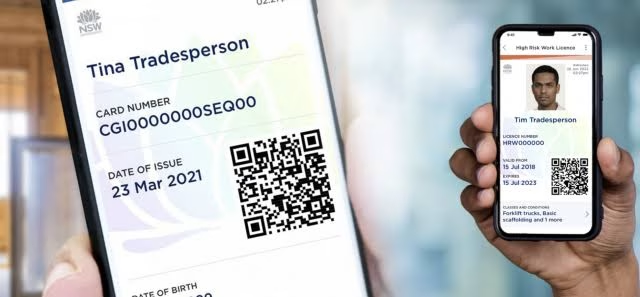
You can check your licence details through the NSW licence register, but a digital wallet version of the contractor licence is not currently confirmed by NSW.
How do I add a new trade class to an existing NSW contractor licence?
You must submit a class variation form through Service NSW, along with evidence of the relevant qualifications and experience for the new trade category.
How do I add a new trade class to an existing NSW contractor licence?
You must submit a class variation form through Service NSW, along with evidence of the relevant qualifications and experience for the new trade category.
What are the main reasons an NSW contractor licence application gets rejected?
An application may be refused if you don’t meet the qualification or experience requirements, are not considered a fit and proper person, or have relevant bankruptcy, criminal, compliance or disciplinary issues.